Rachel Elliot and Will Raphael
The GodmotherRachel Elliot and Will Raphael’s connection grows through encounters in which professional courtesy repeatedly gives way to personal attention. First introduced at an agency gathering, they meet again through Will’s portrait work and become more candid with one another. His attentive care, respect for Rachel’s boundaries, and concrete help in confronting the aftermath of her assault offer a counterpoint to the danger and pressure she experiences at work. Their developing intimacy remains complicated by Rachel’s renewed relationship with Robbie Dexter and by Will’s bereavement.
First Meetings and Mutual Reserve
Will enters Rachel’s life through the advertising world. At a December gathering, Cliff Weybourne points him out as a photographer associated with work for Filmstyle, though Will explains that his involvement is now managerial. Rachel is already uneasy around Cliff and would prefer to leave; when Will approaches, she attempts to make a quick, formal exit. He recognizes her by name, greeting her with a slight bow, while Rachel addresses him as Mr Raphael and emphasizes that she and Anita Cavanagh must be going. The exchange begins with social distance rather than immediate ease: Rachel is wary of the circumstances that brought him into the room, and Will does not press her to remain.
Their next meeting has a quieter setting. At a car park, Will sees Rachel before she notices him, watching as she struggles to feed too many newspapers into a high letterbox and retrieves those she drops. She then drives toward the bottle banks beside the playground fence, where he identifies himself and teases her lightly about recycling. The scene presents them outside the agency’s formal social world, but their manner is still tentative. Will’s attempt to make contact depends on a small observation about what Rachel is doing, rather than on a claim to closeness.
The Portrait as an Invitation
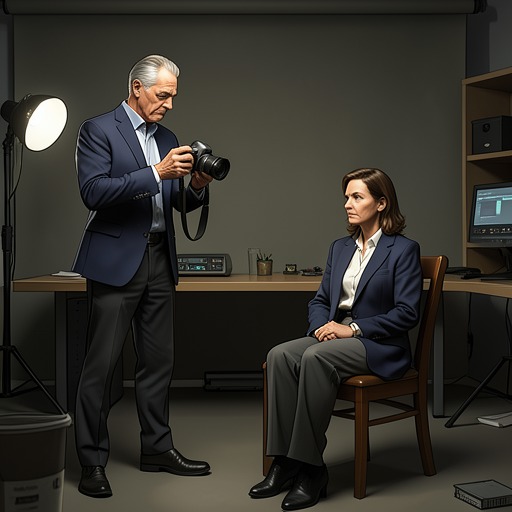
Will asks Rachel if she will sit for a professional photograph, explaining that he is working on a series of portraits based on photographs. The request changes the terms of their acquaintance: he is no longer merely someone she has encountered socially, but an artist asking for her willing participation in a sustained act of looking. Rachel accepts after a New Year’s Eve gathering, when Will again approaches her while Anita is drunk and clinging to him. He holds Rachel’s fingers gently but firmly as he asks whether she will reconsider; Rachel laughs and agrees. His composure in helping Anita remain upright contributes to her impression of him as considerate, even amid the party’s confusion.
The sitting gives their connection a more intimate shape without making it explicitly romantic. Will arranges a yellow-cream sugar-paper backdrop and asks permission before putting his hands on Rachel’s shoulders to guide her through a relaxation exercise. He tells her to breathe in and out slowly ten times. Once he has returned behind the camera, he tells her that she is tense and suggests that fear need not be concealed. Rachel relaxes into the armchair and looks directly into the lens. She remains unnerved, but also elated, and remembers the physical relief of his hands on her shoulders. Her response makes the portrait session more than a technical appointment: it exposes a vulnerability she is accustomed to managing, while the camera gives that moment a deliberate form.
Confidences, Bereavement, and Competing Attachments
At a later gathering, Rachel initially tries to avoid Will, steering Luke away into the crowded room before Will can catch up. When he asks whether she was running away, she admits that she feels out of place and should perhaps not have come. Their conversation includes teasing about her time in Devon and her discomfort with being teased, but Will quickly acknowledges that he hardly knows her and has no right to assume a familiarity she has not offered. This readiness to retreat from the edge of overstepping helps distinguish his attention from coercion.
Rachel asks after Jack, whom she assumes to be Will’s son. Will explains that Jack is his sister Anna Raphael’s child; Anna’s partner left, and Will helps when he can. He also tells Rachel that he once had a wife but no children. Rachel’s response is awkward, and the conversation is interrupted by the party, leaving the disclosure only partly explored. The fuller truth comes when Rachel sees a portrait of the woman on an easel and asks about her: Will explains that she was his wife and that she died. His history therefore enters their relationship not as a completed confidences-for-confidences exchange, but as information Rachel encounters while they are in the midst of making and looking at portraits.
Rachel, meanwhile, tells Will that she is considering a substantial life change and describes her renewed relationship with Robbie Dexter, a former love with whom she has a chance to try again. She admits that she has not told Robbie about agreeing to sit for Will, partly because she is embarrassed and partly because she knows Robbie can be jealous. Her disclosure places Will’s attention within a relationship Rachel hopes may become a shared life, while the dream of motherhood remains present in her thoughts. The attraction between Rachel and Will thus develops alongside, not outside, her commitments and uncertainty about what she wants next.
Trust, Protection, and Unresolved Possibility
The strongest evidence of Will’s care appears when Rachel tells him about a friend who fought off an odious man at work, describing the dilemma of whether to resign, pursue revenge, or face a court case. Rachel has actually been speaking about her own assault, though she presents the experience at a remove. Will does not force her to name herself as the victim. Instead, he offers a photograph that might help the friend obtain revenge, adding that it should be used only if she wants it. Rachel recognizes Cliff Weybourne in the image: he is shown in an embarrassing private scene, wearing a party hat and striped boxer shorts, smoking a joint beside a scantily clad woman.
Will clarifies that Cliff is not his friend. They have crossed paths through work, but Will considers him a snake and tries to avoid him. He identifies Steve Betts as the source of the photograph and imagines that it could be enlarged into a poster or even made into a Valentine card for the agency. The offer is both practical and carefully qualified: Will gives Rachel a possible means of taking action against Cliff, but leaves the decision with her. His response turns the trust established during the portrait session toward Rachel’s workplace crisis, linking personal attentiveness with a willingness to help her recover some agency.
Across these encounters, the relationship moves from formal address and attempted escape to private disclosures, physical ease, and assistance offered without a demand. Rachel’s memory of the portrait session’s bodily intensity, Will’s gentle attention to her distress, and the frankness with which she discusses Robbie and her hopes all suggest an attraction taking shape. Yet the evidence leaves its future open. Rachel remains involved with Robbie, and Will’s bereavement is disclosed without being resolved into a new partnership. Their connection is significant precisely as a developing possibility: intimacy begins to form through restraint, consent, and care, rather than through a declaration or a settled romantic ending.